
Live updates on the US-Israel-Iran war: Trump escalates threats, Iran retaliates, and oil prices surge as the Strait of Hormuz crisis disrupts global markets.

Analysts have largely maintained a bullish outlook on HDFC Bank and ICICI Bank following their Q4FY26 results, though their perspectives on future growth drivers differ. HDFC Bank's near-term performance is tied to accelerating loan growth, while ICICI Bank is seen as a strong candidate for a valuation rerating.

Indian markets on Dalal Street rallied sharply as easing tensions in the US-Iran conflict and stable oil prices boosted sentiment. Track Nifty 50 and BSE Sensex performance and key global triggers.
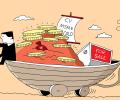
Several non-banking financial companies (NBFCs) are observing an increase in early-stage delinquencies within their micro, small and medium enterprises (MSME) loan portfolios, primarily driven by supply chain disruptions and escalating raw material costs exacerbated by the ongoing conflict in West Asia.

Benchmark indices Sensex and Nifty tumbled in early trade on Friday after a two-day rally, tracking a weak trend in global peers, as the US-Iran conflict continues to be a key overhang for the markets. Track Sensex, Nifty50 movement and key market drivers for March 27, 2026.

Weakness in the information technology (IT) sector hiring has weighed on Info Edge (India) over the past year, leading to a 13 per cent correction in the stock during this period. While the company's 2025-26 (FY26) third-quarter (October-December/Q3) performance showed a marginal improvement, brokerages believe the IT hiring outlook remains weak due to macroeconomic uncertainty in the US.

Indian markets on Dalal Street rallied sharply as easing tensions in the US-Iran conflict and stable oil prices boosted sentiment. Track Nifty 50 and BSE Sensex performance and key global triggers.

Aviation stocks experienced a significant surge following the announcement of a two-week ceasefire between the US and Iran, which led to a sharp decline in crude oil prices. This development has positively impacted stock markets and the broader economic outlook for India.

Indian equity benchmarks, Sensex and Nifty, ended lower after a spectacular rally, with the Sensex tumbling 931 points, as renewed tensions in West Asia, particularly the risk to the ceasefire deal after Iran closed the Strait of Hormuz, dampened investor optimism.

Oracle Corporation has reportedly laid off thousands of employees globally, including a significant number in India, with affected individuals receiving early morning termination emails and immediate laptop lockouts, despite the company posting record quarterly revenues of $17.2 billion.

India's GST revenues experienced significant growth in March, reaching pre-tax cut levels, driven by increased imports and domestic sales. The report analyses the impact of tax rate changes and provides insights into future trends and economic stability.

Foreign Portfolio Investors (FPIs) have withdrawn Rs 19,837 crore from Indian equities in the first two trading sessions of April, extending a significant selling trend from March, driven by geopolitical uncertainty, rising crude oil prices, and a depreciating rupee.

The Left Democratic Front's defeat in Kerala marks a historic moment as Left parties are without power in any state for the first time in decades, highlighting their diminishing political influence across India.

American tennis player Learner Tien discusses the importance of financial awareness and planning for life after tennis, highlighting a growing trend among athletes to broaden their horizons beyond their primary careers.

Traders said fall in demand due to ongoing 'Sharads', an inauspicious fortnight in Hindu mythology for making fresh purchases mainly pulled down the precious metals.

Small- and midcap stocks have delivered their biggest monthly rally in 12 years, but rising oil prices and global tensions could make the road ahead volatile.

These trends not only provide opportunities for entrepreneurial ventures but can also change India, says Roopa Unnikrishnan

India's electric passenger vehicle market saw an 87.4 per cent year-on-year increase in FY26, reaching 233,246 units, primarily driven by the mid-size SUV segment (20-30 lakh price bracket), while the entry-level segment (sub-10 lakh) experienced a decline.

Crude oil prices have surged to record highs due to escalating tensions between the US and Iran, raising concerns about supply disruptions and market volatility.

Among the Sensex stocks, Reliance Industries climbed the most by 3.11 per cent. Bajaj Finance, Titan, Axis Bank, ICICI Bank, Bajaj Finserv, IndusInd Bank, UltraTech Cement, Larsen & Toubro, HDFC Bank, HDFC and Kotak Mahindra Bank were among the other major winners. Power Grid, Hindustan Unilever, Tech Mahindra, Tata Consultancy Services, Infosys and Asian Paints were among the biggest laggards.

State-owned Indian Oil Corporation (IOC), Bharat Petroleum Corporation Ltd (BPCL), and Hindustan Petroleum Corporation Ltd (HPCL) are reportedly incurring losses of Rs 18 per litre on petrol and Rs 35 per litre on diesel, as they continue to absorb rising crude oil costs without increasing retail prices. This situation is leading to expectations of a fuel price hike after upcoming state elections.
Among the Sensex firms, Tata Motors, HDFC Bank, ICICI Bank, HDFC, Bajaj Finserv, Reliance Industries, Hindustan Unilever, Larsen & Toubro, Asian Paints and Tata Steel were the major laggards. Sun Pharma, Titan, ITC, IndusInd Bank, Tech Mahindra and Power Grid were among the winners.

Indian benchmark equity indices experienced a significant downturn, with the Sensex plummeting over 800 points and the Nifty falling sharply, driven by rising crude oil prices, geopolitical tensions, and foreign capital outflows.

Macroeconomic data announcements, global trends and trading activity of foreign investors would be major driving factors for market movement this week, analysts said. Unabated capital infusion by domestic institutional investors have supported the positive trend in the stock market last week, traders said.

Gold prices fell by Rs 400 to Rs 1.6 lakh per 10 grams in the national capital on Thursday amid weak global trends and receding expectations of an interest rate cut by the US Federal Reserve.

'In investing, poor sentiment is always a good vintage to build a portfolio.'

Indian benchmark stock indices Sensex and Nifty rallied for the second consecutive day, closing nearly 1 per cent higher, driven by gains in metal and auto sectors and positive global market trends.

The Sensex jumped nearly 900 points and the Nifty rallied over 272 points on Friday, bouncing back from the previous day's fall, following a positive trend in global equities and fresh foreign fund inflows. The BSE Sensex rallied 899.62 points or 1.53 per cent to end at 59,808.97 after starting the trade on a positive note. During the day, it jumped 1,057.69 points or 1.79 per cent to 59,967.04.

Analysts say long-term investors may still benefit, but recommend limiting bullion exposure to around 10 per cent.

Even if there is an early agreement on a cessation of hostilities in West Asia, the price shock will not go away easily, points out A K Bhattacharya.

Foreign investors have withdrawn a record Rs 1.14 lakh crore from Indian equities in March, driven by geopolitical tensions, a weakening rupee, and concerns about crude oil prices.

Ranveer Singh's Dhurandhar: The Revenge is smashing box office records, raking in Rs 681.27 crore (Rs 6.81 billion) in India and exceeding Rs 1,000 crore (Rs 10 billion) worldwide, solidifying the actor's status as a bankable star. Check daily collection, trends, and box office performance.

The stock market is likely to continue with its positive momentum but may face bouts of profit-booking amid lofty valuations in this holiday-shortened week, analysts said. The trading sentiment will be guided mostly by global trends in absence of major domestic events, they said. Markets would remain closed on Friday for 'Ganesh Chaturthi'.

With growing opportunities in the coaching, sports science, training and wellness industries, a career in sports provides a dynamic and fulfilling career path.

'Travellers are considering safer and more stable destinations.'

Benchmark stock indices Sensex and Nifty fell for the third day running on Friday due to weak trends in global markets and soaring crude oil prices. Foreign fund outflows also weighed on investor sentiments amid strengthening US bond yields which are nearing 5 per cent for the first time since 2007. The 30-share BSE Sensex fell 231.62 points or 0.35 per cent to settle at 65,397.62.

Artificial intelligence (AI) is emerging as a potential new demand driver for India's office market, with AI-focused technology (tech) firms actively leasing new office space and established information technology (IT) companies expanding their footprint as they ramp up investments in AI.

India's manufacturing sector growth slowed to a four-year low in March, impacted by cost pressures, competition, market uncertainty, and the Middle East conflict, according to the HSBC India Manufacturing PMI.
Indian stock markets tumbled sharply with the Sensex falling 800 points and nearly 4 lakh crore wiped out in a single session. Here are the 6 key factors, including rupee weakness and global cues, behind the crash.
Disappointing quarterly earnings numbers and revenue forecast from IT services company Wipro also weighed on investor sentiments. The 30-share BSE Sensex fell 247.78 points or 0.38 per cent to settle at 65,629.24 points. During the day, it plunged 533.52 points or 0.80 per cent to 65,343.50 points.
